
The Vickers Family of Vickers Row
The Vickers Family, Vickers Row, Station Road
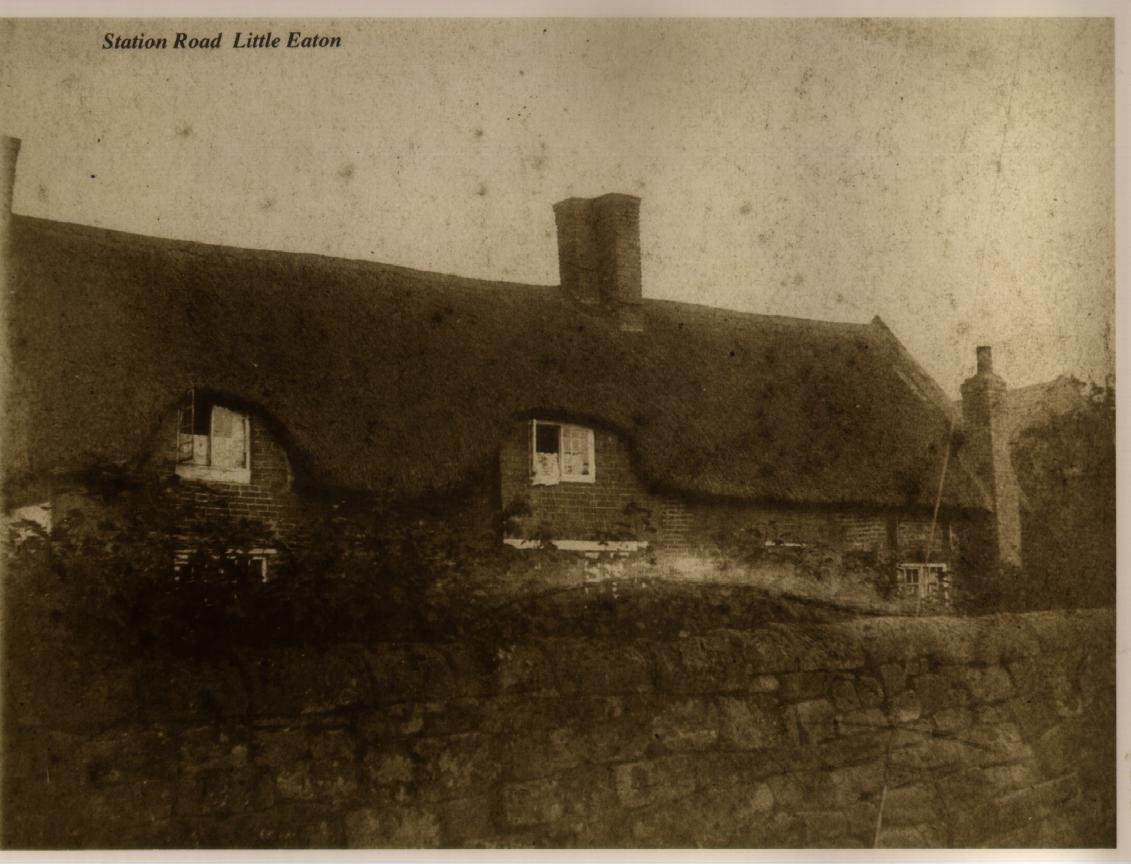
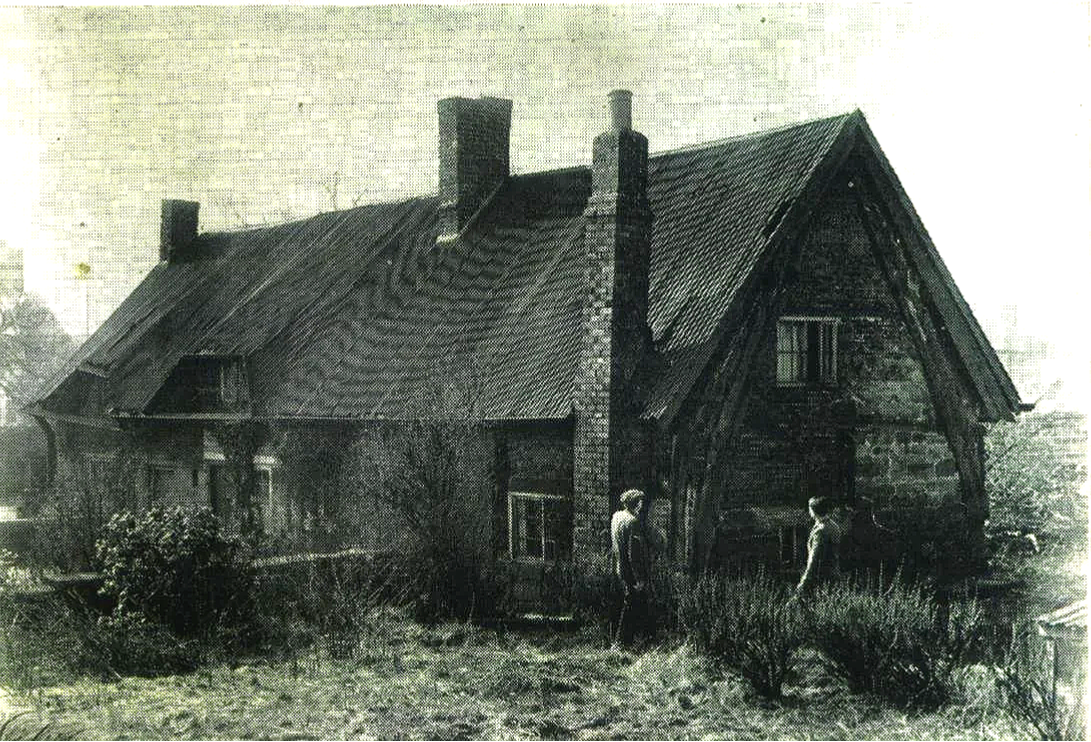
Vickers Row was a row of three cottages, a building of crick, lath and plaster with a thatched roof. It was called Vickers Row after the family of farmers that lived there in the early 1800s. Later called Station Row, due to its proximity to Little Eaton station when the railway opened in 1856. Several generations lived there, and it came to be known as Redferns Farm in the late 19th Century, until eventually the old building was demolished in the 1950 s, replaced by semi detached houses.
This article covers the family’s history, including the links to Cathie Woodward’s family, captured in the book Little Eaton: A Native’s Tale.
John and Hannah Vickers
John Vickers (1786-1861) was the second son of William Vickers (1737-1831) who was a cowkeeper, a baker and an agent for stone and coal. The Court Rolls tell us that William Vickers gave John some land before John was 21. This included The Benzor Pingle (a small field used for growing beans); The Pyke (land tapering to a point); and Oakley Roods. The rest of William’s estate was bequeathed to John in William’s will, with the exception of £40 to John's older brother and £40 to each of John’s two married sisters.
John’s land included 2 cottages, an orchard and a meadow and garden and “all outhouses and appurtenances, edifices and buildings”. John also had another small pingle near Jack O’Darley Bridge and Mason’s Croft and messuage (cottage). He was copyholder of a quarry (rateable value £25), an Agent for coal and stone, a cowkeeper and later a baker and a framework knitter.
John Vickers was a very busy man!
John Vickers married Hannah Clifford (1791-1851) in 1816. John followed in his father’s footsteps, although by 1823, he is recorded on his youngest son’s birth record as a framework knitter, and on the 1841 Census he and Hannah were registered as farmers and also as framework knitters.
John and Hannah lived in one of the 3 cottages at Vickers Row.
They had at least 7 children: The first three were born in Spondon where their mother (Hannah) came from. William, Hannah, Frances and James were born at Vicker’s Row in Little Eaton.
Their children were:
Mary b. 1809. Mary died in 1810 aged 5 months
John 1812 - 1878
Mary b. 1814 . Mary may have died in 1837.
William 1816 - 1886
Hannah 1819 - 1883
Frances 1821-1884
James 1823-1872
In 1841, John and Hannah Vickers and most of their family + 3 others were working as weavers and framework knitters and living at Vickers Row in 1841 when the census was taken. Their eldest son John and eldest daughter Mary have left home. Daughter Hannah and her husband Robert Fletcher and their one-year-old son, John are still living with them, as are Frances, aged 20 and William aged 25. James is working in the family quarry.
By the 1851 Census, John Vickers gave his occupation as cowkeeper. His wife, Hannah died in 1851. Son William had left home and married in 1842. Daughter Hannah and her husband Robert, and Frances, and Thomas Dawson, are all listed as glove stitchers. Thomas Dawson (b.1818), an agricultural worker stayed with the family for nearly 40 years.
The next Vickers Generation mid 19th Century
John Vickers (1812-1861), the eldest son of John and Hannah Vickers of Vickers Row married Ann Gregory (1816- 1892) in 1834. John was variously a quarryman, a stone getter, a stockinger. They lived in Little Eaton until about 1852, possibly at or near Vickers’ Row.
Their first child John (b.1832) was born when Ann was 16, before they were married. 5 more children (including Victoria* b. 1847, mentioned as Kate’s sister on Page 87 of A Native’s Tale ), were born in Little Eaton village, then they moved to Northfields, Breadsall. Here their youngest 4 children, including Catherine ( Kate ), born 1854, were born. Northfields, Breadsall was part of the Harpur-Crewe estate. Near neighbours were the Garrett Family also farming at Northfields, later called Moor End Farm.
[ In” A Native’s Tale” by Cathie Woodward, family tales and memories passed down through the generations, Kate is the daughter of John’s younger brother William. Research now shows that Kate and her brothers and sisters were the children of John and Ann Vickers ]
On 13th March 1853 five of the Vickers’ children (11 year- old Ann to 2 year- old Joseph) were baptised at St Paul’s church all on the same day. This may have been because 11 year- old Ann was ill and died later that month.
John and Ann’s sons: John, Walter, Roger, James, Joseph and William either moved away from Little Eaton to Chesterfield, Bradford etc, or didn’t marry, or were widowed young, or died young (eg: Roger who died aged 27). The youngest, William, born 1859, lived, unmarried with his widowed mother, a farmer of 20 acres in Breadsall, The Moor, until she died, and then continued to live at Moorside, still single, becoming a platelayer for the railway.
John and Ann Vickers’ youngest daughter Catherine (Kate), born in 1854, married William Henry Piggs:
“William Henry Piggs married Catherine Vickers, daughter of John and Ann (née Gregory) Vickers of Breadsall at All Saints Church, Breadsall, on 13th September 1874, by Rev H. A. Stowell” (Hugh Ashworth Stowell) . Newspaper reports 1874: Derbyshire Times. Derby Daily Telegraph.
Hannah (1819-1883) and Robert Fletcher (1813 - 1879) went on to have 5 more children and continued to live at Vickers Row with Hannah’s father until 1860, when they lived next door to Robert Harvey in The Town. One of their daughters Sarah (b. 1843) married Jabez Salmon (1841-1872) of Church Farm/Tempest Farm in 1866 and farmed there after her husband died until 1910.
Frances never married. She stayed on at Vickers Row after her parents died and farmed 20 acres there with an agricultural worker called Thomas Dawson (b. 1818) who worked for the Vickers family for 40 years. Frances Vickers and Thomas Dawson may have moved to or at least worked at Church Farm by 1871 with Frances’ niece Sarah Salmon (nee Fletcher).
The youngest son, James, became a stone getter. He married Elizabeth Ewin in 1848. They lived in Cheadle in Staffordshire where James continued working in a quarry. The couple had 5 children. James died in 1872 aged 50.
Second son William:
Cathie Woodward’s book A Native’s Tale says that William gave up framework knitting and went to work at Church Farm, and married Anne Salmon, the farmer’s daughter in 1851. The farmers at Church farm at that time were not called Salmon, so it is more likely that William married Lucy Roberts in 1842, at St Alkmunds. They continued to live at Vickers Row and had 11 children, including Sarah Vickers, born 1860 who later, (1891) married Henry Redfern and with him continued to farm at Vickers Row. William is recorded as a framework knitter in 1841, a coal dealer in 1851, a stone carter in 1861, a higgler (a trader), and later as a farmer of 18 acres at Vickers Row, employing one man. When he died in 1889, he left about £34 to his two eldest sons Jonathan and Joshua who were named as his executors. Jonathan and Joshua had both left Little Eaton for Chesterfield and Lancashire respectively. Their brother Richard had died aged 7 in 1853 and their two other brothers didn’t marry. This gives some indication of why the Vickers name began to die out in Little Eaton.
Vickers Row becomes Redfern’s Farm
William and Lucy’s youngest daughter, Sarah Vickers married Henry Redfern in 1891 and continued to live and farm at Vickers Row. Henry was a carter and a cowkeeper. The couple had 4 children, one of whom was William Redfern, (b.1894) who, with his sisters Caroline, Lucy and Lily helped his widowed mother to run the farm when his father died in 1907 and took over the farm by about 1914. William delivered milk to many houses in Little Eaton.
Vickers Row began to be called Redferns’ Farm, Station Road. Cows from Redferns’ Farm and Church Farm were taken daily through the village to be milked, making Wlliam and his herd a familiar sight to villagers.
In 1929 William, dairy farmer, married Nelly and they were still in residence in 1939 but by the mid- 1950s the Vickers Row cottages were demolished and the farm disappeared. 2 pairs of bungalows for elderly residents and 2 semi-detached houses were built on the site.
William Redfern delivering milk.
